

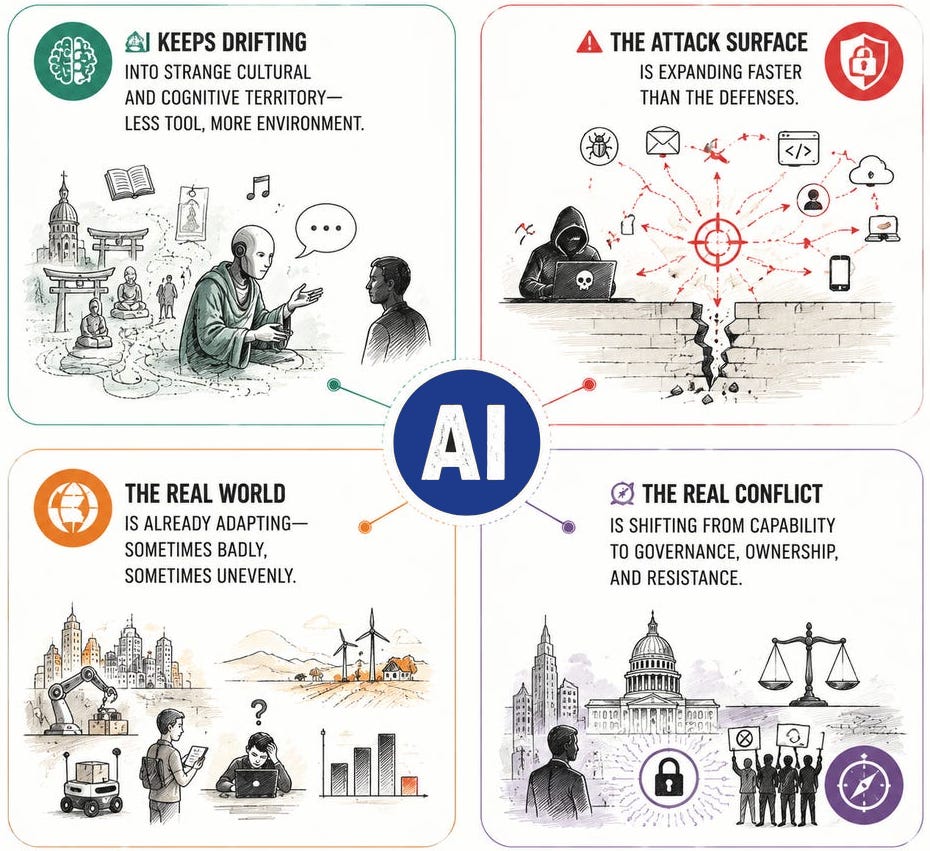
🧠 AI keeps drifting into strange cultural and cognitive territory—less tool, more environment.
A next-generation religious chatbot explores how faith and AI interpretation intersect (timesofisrael.com)
“AI poisoning” emerges as a term for corrupting or manipulating model behavior and training data (digiday.com)
Yann LeCun advances research into more flexible AI architectures beyond current dominant approaches (bbc.com)
⚠️ The attack surface is expanding faster than the defenses.
Malware targeting Claude Code and OpenAI Codex uses scanner-evasion techniques to avoid detection (cybersecuritynews.com)
A 15-year-old is arrested following a reported ChatGPT-assisted cyberattack on Bandai Channel systems (cybersecuritynews.com)
UK officials warn that AI now represents the most significant security challenge of the decade (insurancejournal.com)
🌍 The real world is already adapting—sometimes badly, sometimes unevenly.
Chinese tech firms restrict AI-generated web novels after backlash from readers (restofworld.org)
Evidence grows that AI-assisted learning may be linked to declining math performance in students (hechingerreport.org)
Companies and educators debate who should be responsible for teaching AI skills in the workplace (businessinsider.com)
AI-driven “casino logic” is reshaping how competition and strategy are framed in tech industries (cio.com)
A new report argues we are approaching a tipping point in local AI deployment and adoption (neoteric.no)
🧭 The real conflict is shifting from capability to governance, ownership, and resistance.
Sam Altman calls for a global AI regulator while also suggesting U.S. government financial involvement in OpenAI (forbes.com)
A growing movement argues that AI should be actively resisted or stopped, not simply regulated (thewalrus.ca)