

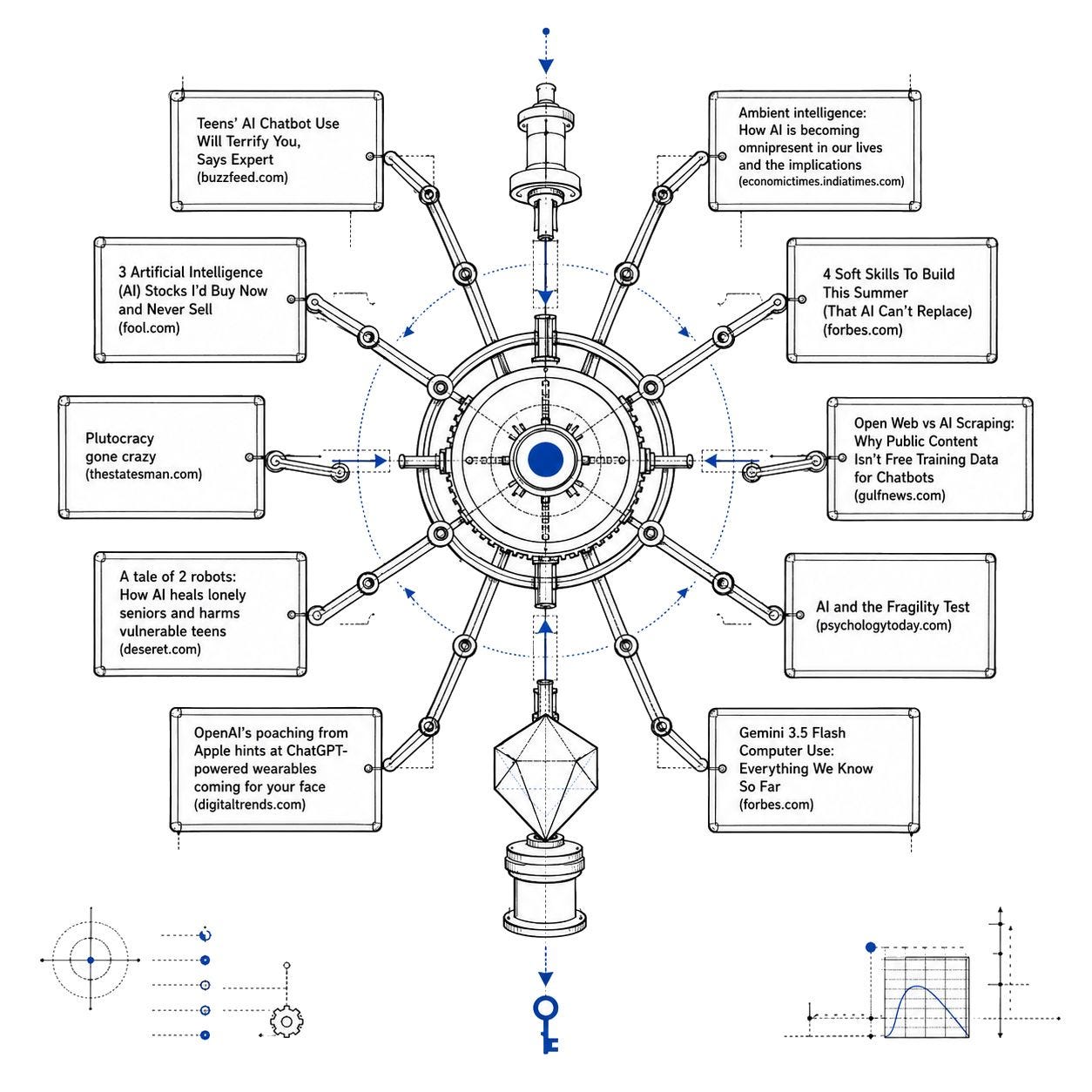
The AI story this week begins with an unsettling thought: the biggest change isn’t that AI is becoming smarter, it’s that we’re slowly forgetting where it ends and everyday life begins (economictimes.indiatimes.com).
That shift is happening faster than most people realize. The next generation of AI won’t simply answer questions; it will click buttons, use software, and complete tasks on our behalf, turning computers into something we manage less and delegate more. (forbes.com)
And if the latest industry moves are any indication, those assistants won’t stay trapped inside our laptops for long. The race is already moving toward AI-powered wearables that could follow us everywhere, making the assistant less of an app and more of a permanent companion. (digitaltrends.com)
Investors certainly believe that’s where we’re headed (fool.com). Capital continues to flood into AI companies, driven by the conviction that today’s leaders are building the infrastructure of tomorrow’s economy.
But every technological revolution creates new concentrations of power, and AI is proving no exception (thestatesman.com). As wealth, talent, and computing resources gather around a handful of giants, critics are asking whether we’re witnessing innovation—or the rise of a new digital plutocracy.
That concentration of power depends on something else: data (gulfnews.com). Yet publishers and creators are increasingly refusing to accept the idea that everything published on the web is automatically free fuel for AI models, setting the stage for a defining legal battle over who owns the knowledge that machines learn from.
Meanwhile, the technology itself is revealing a more complicated personality (deseret.com). In one setting, AI is helping lonely seniors reconnect with the world and reducing isolation in meaningful ways.
In another, the same technology is becoming deeply embedded in the lives of teenagers (buzzfeed.com), raising uncomfortable questions about emotional dependence, manipulation, and what happens when an artificial companion becomes more influential than a real one.
Psychologists (psychologytoday.com) increasingly see this not as a test of artificial intelligence, but as a test of human intelligence, of our resilience, our judgment, and our ability to remain emotionally grounded while living alongside machines designed to understand us.
Which is why perhaps the most important lesson this week isn’t about AI at all (forbes.com). As machines become better at logic, speed, and automation, the qualities growing most valuable are the ones they still struggle to reproduce: empathy, communication, trust, creativity, and wisdom.
The AI story is no longer about whether the technology works—it clearly does. The real story is that AI is quietly becoming part of the fabric of everyday life. The next chapter won’t be written by faster models alone, but by how well we decide to live with them.